

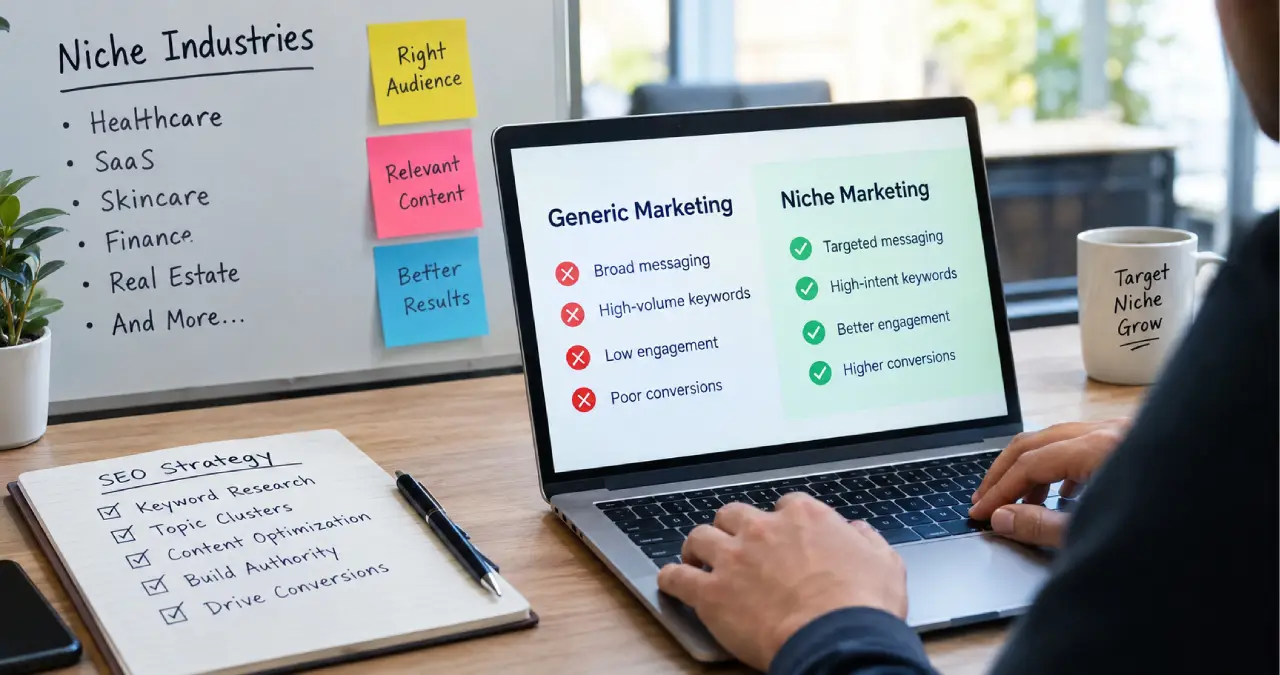
Generic marketing often falls flat in conversation, speaking to everyone but connecting with no one. Picture this. There are a plethora of industries like healthcare, SaaS, and skincare with their unique buyer language, search behaviour and quirks. Still, when it comes to execution, their rhetorical pattern of a recycled playbook brought failure, as they followed it with broad messaging and broad keyword choices and kept failing.
The problem seriously jeopardises their search performance. The chase over generic content fails to rank their content, as they are looking for high-volume keywords, not the high-intent ones that actually matter. Generic templates simply fall short of delivering the regulated, technical, or hyper-local value a niche audience is actually looking for.
The SEO Case for Industry-Specific Marketing Strategy
Specialization is never merely a choice of positioning; rather, it is an SEO driven advantage. Content that fulfils real topical authority and maintains E-E-A-T (Experience, Expertise, Authoritativeness, Trustworthiness) is always rewarded by the search engine for a specified niche. Shallow coverage of content, on the other hand, never outranks it.
If a site delivers value through its industry-specific topical relevance with long-tail keywords, it would be hard to replicate with generic content. This is exactly where niche industry marketing solutions like Ignite Digital come in. It guides buyer intent mapping, keyword research and SERP analysis. The messaging and content clustering make them appropriate for what buyers are actually searching for. Their endeavours paid off, as it promises stronger topical authority, better rankings and may help in stronger conversion potential.
Pros of niche marketing and why it matters
| Pros of Niche Marketing | Why It Matters |
| Sharpens brand identity | Specialization doesn’t flatten brands — it sharpens them |
| Faster, deeper insight | Existing industry knowledge means agencies skip the learning curve and go straight to refining positioning |
| Consistent presence | Tone stays consistent, visuals reinforce positioning, and audiences recognize the brand instantly |
| Distinctiveness | The more defined a brand’s voice becomes, the more distinct it feels within a crowded niche |
Transforming Industry Insight Into SEO-Driven Results
Knowing the niche is half the battle; the other half is structuring search visibility and a way to ensure conversion.
| Approach | What It Does |
| Long-tail keywords | Targets specific intent over broad, competitive terms |
| Topic clusters | Strengthen topical authority, boost crawlability and internal linking |
| Snippet optimization | Structures content (lists, definitions, direct answers) to win position zero |
| Intent-based messaging | Matches content to funnel stage — research to ready-to-buy |
Why opt for niche marketing over generic marketing
Unlike generic marketing, Niche marketing targets specific, lower-competition keywords with higher buyer intent. It also helps the brand to gauge topical authority faster and deliver real industry fluency that search engines consider rewarding. Relevance every time outshines reach, and in search, relevance is the thing that always gets rewarded.
Sources and Editorial Notes
Elivestory aims to use relevant sources, separate confirmed information from speculation and update important details when reliable new information becomes available.

Editor
Fastlinky is the #1 agency for creative high quality link building services and we are experts in SEO and outreach services that will boost your website's performance.
View All Articles

