By Sarah Jay · Updated November 26, 2026 · Compiled from reporting by Reuters, Bloomberg, Yahoo Finance and Al Jazeera, cross-checked against each other. Nothing here is sponsored.
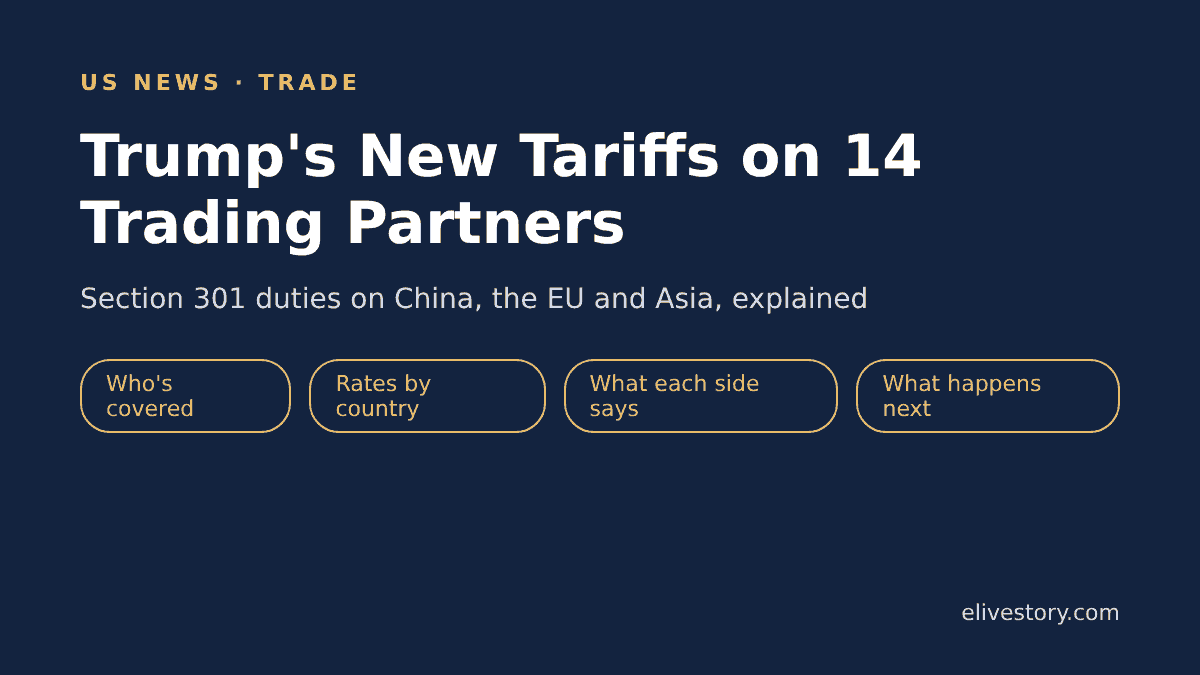
Trump’s new tariffs target 14 trading partners, including China and the European Union, under a trade law the administration says will hold up in court. The Office of the US Trade Representative proposed the duties on Wednesday, Nov. 25, saying they answer “structural excess capacity” in foreign factories. Nothing takes effect yet: a public hearing is set for Jan. 25, according to Reuters.
The move comes three weeks after Republicans lost both chambers of Congress in midterms where prices and tariffs were central issues. It also replaces part of the tariff wall the Supreme Court knocked down in February.
Here’s what was proposed, who’s covered, what each side is saying and what happens between now and January.
What did the Trump administration announce?
USTR published proposed tariffs on imports from 14 economies after an investigation it opened in March. That probe looked at 16 economies in total. Two of them, Mexico and Norway, were left out of this round because their reviews are still under way, US Trade Representative Jamieson Greer said, per Reuters.
The legal basis is Section 301 of the Trade Act of 1974. It’s the same tool Trump used against China in his first term, and those tariffs survived court challenges. Reuters described the goal as putting the tariffs and the trade deals built around them on “more solid legal and political grounds.”
An unnamed US official who briefed reporters put the case bluntly. “This is not a new issue, unfortunately,” the official said, according to Yahoo Finance. “It’s created severe imbalances globally, and it’s harmed US commerce in particular.”
Greer, in comments reported by Reuters, said the tariffs target “industrial strategies built on targeting manufacturing, wage and labour suppression, financial and other support, non-market economy inputs, and other market-distorting practices.”
Which countries face Trump’s new tariffs, and at what rates?
The 14 economies are China, the EU, Japan, South Korea, Taiwan, Switzerland, India, Vietnam, Singapore, Thailand, Malaysia, Indonesia, Cambodia and Bangladesh. Reuters and Bloomberg agree on the list.
Most of the rates are tied to trade deals that countries signed with Washington over the past year. Reuters reported these proposed levels:
- China: 20%, rising to 40% if the US-China trade truce collapses
- Vietnam: 20% with a trade agreement, 35% if talks fail
- India: 17% if a deal is finalized, 25% if it isn’t
- Cambodia, Indonesia, Malaysia, Thailand and Bangladesh: 18%
- Japan, South Korea, Taiwan, the EU and Switzerland: capped at 15%, including existing most-favored-nation duties
- Singapore: 10%
Not every outlet tells it the same way. Bloomberg reported that the EU and Switzerland could go as high as 20% and South Korea as high as 25%, while Yahoo Finance said the EU, Japan and Korea aren’t expected to exceed 15%. Al Jazeera, citing earlier Reuters reporting, put Malaysia at 19%, not 18%. Expect the final Federal Register notice to settle these.
Greer told CNBC the administration is “sticking to” the deal levels “because we think a lot of these deals we made actually solve a lot of the problems we see in excess capacity or can go toward it,” according to Reuters. He added, per Bloomberg: “If we were to go beyond the 20% or something like that, they would view that as breaking our deal.”
What’s excluded
Several product groups are carved out. Both Bloomberg and Yahoo Finance list semiconductors, oil and gas, and food that can’t be grown in the US. Goods already under separate national-security tariffs, such as steel, aluminum and cars, are also excluded. Bloomberg adds pharmaceuticals and critical minerals.
Stacking is the messiest part. Greer said the new duties won’t pile on top of the 10% to 12.5% “forced labor” tariffs imposed on about 60 economies in July. “Those are not really additive,” he said, per Bloomberg, which reported that only the higher rate applies where both cover the same goods. Yahoo Finance, though, reported that China’s 20% would sit on top of some existing tariffs, pushing the total above 40% in some areas. Reuters said it adds to the roughly 25% left from Trump’s first term.
Brazil gets its own action
Separately, USTR proposed a 10% tariff on finished commercial aircraft from Brazil and higher duties on Brazilian sugar above quota, Reuters and Bloomberg reported. Greer said talks with Brazil had made “no meaningful progress.”
Why is Trump using Section 301 now?
Because the old approach lost in court. In February, the Supreme Court ruled that Trump’s broad country-by-country tariffs weren’t allowed under the national emergencies law he’d used. Those were the “Liberation Day” duties from April 2025.
The administration then leaned on a temporary 10% tariff, which expired in July, and the forced-labor Section 301 tariffs. Importers are challenging those at the US Court of International Trade.
Section 301 is slower. It requires investigations, hearings and public comment. Bloomberg called it “more time-consuming” but “seen as more resistant to legal challenges.” Ed Mills of Raymond James described the new duties to clients as “an effort to restore the previous tariff structure” that existed before the court stepped in, Yahoo Finance reported.
The numbers show why. The Yale Budget Lab put the effective US tariff rate at about 11.3% in November, down from 13.86% just before the Supreme Court ruling, per Yahoo Finance.
What each side says
China rejected the premise. “The so-called issue of ‘industrial overcapacity’ does not really exist and should not be used as a pretext for political manipulation,” a spokesperson for the Chinese embassy in Washington said, according to Reuters. Foreign Ministry spokesman Guo Jiakun called it “political maneuvering,” Bloomberg reported, but said both sides should work to keep the truce. China said it “reserved the right” to respond, per Reuters.
The EU pushed back too. “We strongly reject the premise that Europe is a source of structural overcapacity,” European Commission spokesman Olof Gill said, per Bloomberg. The bloc expects any levy to respect its 15% deal.
On Capitol Hill, Sen. Ron Wyden of Oregon, the Democrat expected to chair the Senate Finance Committee in January, went straight to prices. “Trump has decided to yet again increase prices for Americans,” he said, according to Reuters. He pledged to “use every tool at my disposal to end Trump’s disastrous tariffs.”
Outside analysts split on the legal and political odds. Trade policy expert Dmitry Grozoubinski told Al Jazeera the law “is supposed to be a scalpel, and they used it like a flamethrower,” though he also said these are probably the strongest of Trump’s tariffs on legal grounds. Nathaniel Halvorson, a former USTR official now at Baker McKenzie, told Reuters there’s bipartisan support for countering China-centered overcapacity, which could make the tariffs hard for Democrats to unwind.
What happens next
The proposal still has to clear a public process. Reuters reported the duties won’t take effect until after a Jan. 25 public hearing. Yahoo Finance said January is the earliest realistic start.
Two dates come first. The US-China trade truce expires Jan. 10, and Trump and Chinese leader Xi Jinping are expected to meet in December, Bloomberg and Reuters reported. Whether China lands at 20% or 40% likely depends on that meeting.
Then there’s Congress. Democrats take control of both chambers in January. They can hold hearings and pass bills, but Trump can veto them, and overriding a veto takes two-thirds of each chamber. A Reuters/Ipsos poll after the midterms found 62% of respondents backed Democrats’ efforts to repeal tariffs.
Markets mostly shrugged. Stocks in Europe and Asia rose Thursday because the news was largely expected, Reuters reported. “I think a lot of this is baked in,” Greer told CNBC, per Bloomberg.
Why it matters for Americans
Tariffs are paid by US importers, and some of that cost usually reaches shoppers. Neither the administration nor the outlets I reviewed has published an estimate of what these specific duties would add to consumer prices, and Yale’s Budget Lab hasn’t yet scored them.
In my view, the bigger signal is political. Trump lost the House and Senate in a cost-of-living election and still chose to rebuild his tariff system, using the law most likely to survive the courts. That sets up a clear fight with the incoming Democratic majority early next year. It also gives trading partners a reason to keep negotiating rather than retaliating, which is what most of them, apart from China, have done so far.
FAQ
What are Trump’s new tariffs?
They’re proposed import duties on 14 economies, including China and the EU, announced by the US Trade Representative on Nov. 25, 2026. They’re based on Section 301 of the Trade Act of 1974 and target what the administration calls structural excess factory capacity. Rates range from 10% to 20% for now, with higher levels possible if trade talks fail.
When do the new tariffs take effect?
Not yet. Reuters reported they won’t start until after a public hearing on Jan. 25. Yahoo Finance reported that January is the earliest likely start date.
How much is the new tariff on China?
The proposed rate is 20%. Reuters and Bloomberg reported it could rise to 40% if the US-China trade truce, which expires Jan. 10, isn’t extended. Outlets differ on how it combines with existing tariffs on Chinese goods.
Are the EU, Japan and South Korea affected?
Yes. Reuters reported their rate is capped at 15%, including existing duties, in line with trade deals they signed with Washington. Bloomberg reported the EU could face up to 20% and South Korea up to 25%, so the final numbers aren’t settled.
Can Democrats stop the tariffs?
They can try once they take over Congress in January, but Trump can veto any bill that repeals them. Overriding a veto needs two-thirds of both the House and Senate. Sen. Ron Wyden has said he’ll use “every tool” to end the tariffs.
Why didn’t the Supreme Court ruling stop these tariffs?
The February ruling struck down tariffs imposed under a national emergencies law. These new duties use Section 301, a different trade statute with a required investigation and hearing process. Trump’s first-term Section 301 tariffs on China survived court challenges.
Related on elivestory: 2026 midterm election results, what the Trump-Xi-Putin summit produced and why the S&P 500 fell into a correction.
Sources: Reuters via Investing.com, Reuters via The Korea Times, Bloomberg via gCaptain, Yahoo Finance, Al Jazeera.
This story is developing. Rates may change when the proposal is published in the Federal Register.
Sources and Editorial Notes
Elivestory aims to use relevant sources, separate confirmed information from speculation and update important details when reliable new information becomes available.

Sarah Jay
Sarah Jay is a journalist, fact-checker, and writer who creates well-researched articles using information from credible and trusted sources. She combines verified facts with thoughtful analysis, offering readers clear, balanced, and insightful perspectives on the topics she covers.
View All Articles