By Sarah Jay · Updated November 21, 2026 · Compiled from reporting by CBS News, RFE/RL, ABC News, Fox News, National Security Journal and The National Desk, cross-checked against each other. Nothing here is sponsored.
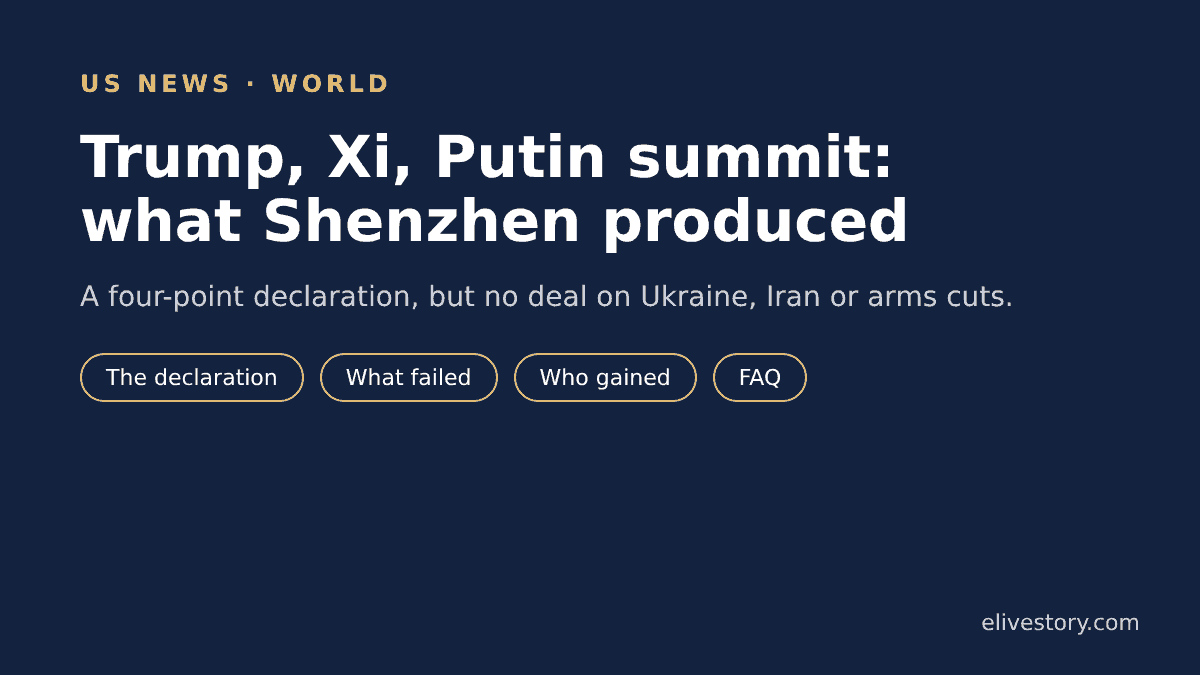
The Trump Xi Putin summit in Shenzhen ended with a four-point joint declaration and no breakthrough on Ukraine, Iran or nuclear arms cuts. President Trump, Chinese President Xi Jinping and Russian President Vladimir Putin met for about an hour and a half on Thursday, November 19, on the sidelines of the APEC summit. It was the first three-way meeting of its kind. Back at the White House on Friday, Trump called it historic and said there was “great electricity” between the three leaders.
Most analysts read it differently. Here’s what was actually agreed, what wasn’t, and who came away with the most.
What the Shenzhen joint declaration says
The Kremlin released the joint statement first, and the White House later put out the same text, CBS News reported. It has four main commitments.
- Reforming the United Nations. No restructuring plan was attached.
- Increasing the production and supply of refined petroleum products, and keeping energy flows stable. CBS summarized this as a pledge to raise oil and gas output “for the benefit of all countries.”
- Respecting state consent and the immunity of state officials, with a line that the International Criminal Court and similar bodies “must not abuse their jurisdiction.”
- Holding talks on reducing nuclear risks and preventing proliferation, and reaffirming that a nuclear war “cannot be won and must never be fought.”
That nuclear line isn’t new. The five recognized nuclear powers already issued it in January 2022, National Security Journal noted. The declaration commits the three countries to dialogue on nuclear risk, but stops short of arms-control negotiations or any cut to stockpiles.
What didn’t happen
Ukraine was the biggest gap.
The leaders discussed the war, but the only firm statement on it came from Putin afterward. He ruled out direct negotiations with Ukraine, citing a Ukrainian drone and missile strike earlier that week on the Kerch Bridge in Crimea, and said Ukraine and Europe were “not yet ready” for the needed compromises, according to CBS News. Trump is still pushing for a three-way meeting with Putin and Ukrainian President Volodymyr Zelensky, possibly at next month’s G20 summit in Miami.
Iran came up short too. The US has been at war with Iran for almost nine months, and China and Russia both have close ties to Tehran. The joint statement doesn’t name the conflict, and neither Putin nor Xi mentioned it at APEC, RFE/RL reported. Iran launched drone and missile strikes on Bahrain and Kuwait the day before the summit.
On nuclear arms, the gap between the three is wide. The US and Russia each hold more than 5,000 warheads; China has an estimated 600 or so. Beijing considers joining disarmament talks premature. Xi did reportedly call nuclear weapons a “sword of Damocles hanging over humanity,” per CBS, but China agreed only to the vague risk-reduction dialogue.
One more absence: North Korean leader Kim Jong-un left APEC without meeting Trump, even though Trump had said they might meet.
Who gained the most from the summit?
Putin, according to most of the analysts quoted.
He arrived as the most isolated of the three, after years of Western pressure over the 2022 invasion of Ukraine. This was his first APEC since 2017. “Putin came away with a lot. He was the biggest winner at this meeting,” Elizabeth Wishnick of the CNA Corporation told RFE/RL.
Two parts of the declaration line up closely with Russian interests. The ICC language matters because the court issued an arrest warrant for Putin in March 2023 over the alleged deportation of Ukrainian children. The refined-petroleum pledge, RFE/RL argued, effectively endorses Russia’s struggling oil sector. Russian state media reported that Putin left in an “excellent mood.”
Xi also did well. He hosted, set the stage and gave up little. Yun Sun of the Stimson Center called the event “high-profile and well-choreographed” and said “you can call it a success” for China. Xinhua described the meeting as “positive, constructive and fruitful.”
Trump, analysts said, set low expectations and met them. He wanted to be on record pursuing nuclear arms control with the other two major nuclear powers, one analyst told RFE/RL, and he got that.
What Trump said afterward
Trump left Shenzhen without taking questions, then held a White House news conference on Friday, November 20. He said the three countries made strides toward denuclearization talks and that “our country is safe because of that,” ABC News reported.
He also stood by calling Putin his “friend.” Pressed on whether Putin really wants peace, Trump pointed to what he called “tremendous hatred” between the two sides as the main obstacle, Scripps News reported. Earlier, he’d told NBC News the meeting was a “12 out of 10.”
Not everyone agreed with the tone. “Vladimir Putin is not a friend,” Democratic Sen. Tim Kaine of Virginia said, criticizing Trump’s remarks.
The Trump-Xi meeting and trade
Separately from the three-way talks, Trump met Xi for about an hour, and Putin on his own as well. Trade dominated the US-China conversation. Trump said he’d ask China to “do some more” for American farmers, and Xi called relations “stable and improved,” per CBS.
The timing matters for American businesses and farmers. The two countries fought a trade war in 2025 with tariffs above 100%, and the current tariff truce runs out on January 10. Nothing announced in Shenzhen extended it.
Xi also urged cooperation on AI risks and keeping humans in control, according to China’s summary of the meeting. That sits awkwardly next to Trump’s APEC pledge to block “globalist regulation” of AI.
What the Shenzhen summit means
The headline result is symbolic. Three leaders who rarely agree signed one page of broad principles, and most of the hard questions moved to later meetings that may or may not happen.
My read is that the dates to watch are concrete ones. The G20 in Miami next month will show whether Trump can get Putin and Zelensky in a room. January 10 will show whether the US-China tariff truce survives. And the nuclear risk dialogue will only mean something if officials actually schedule talks.
Wishnick put the limits bluntly to RFE/RL: “The days of leaders sitting around a table and deciding the fate of the world are over.”
FAQ
What did Trump, Xi and Putin agree to in Shenzhen?
They signed a four-point declaration on November 19, 2026. It calls for UN reform, more production and supply of refined petroleum products, respect for state officials’ immunity and limits on the International Criminal Court, and talks on reducing nuclear risks. It includes no arms reduction and no deal on Ukraine or Iran.
Did the Trump Xi Putin summit end the war in Ukraine?
No. Putin ruled out direct talks with Ukraine after the meeting, citing a Ukrainian strike on the Crimea bridge. Trump is still pushing for a meeting with Putin and Zelensky, possibly at the G20 in Miami next month.
Who won the Trump Xi Putin summit?
Several analysts said Putin gained the most, mainly by ending some of his diplomatic isolation and getting favorable language on the ICC and oil. Xi was seen as a successful host. Analysts described Trump’s results as modest.
Was nuclear disarmament agreed at the summit?
No. The leaders agreed to hold dialogue on reducing nuclear risks and preventing proliferation, and repeated that a nuclear war cannot be won. There’s no commitment to cut warheads, and China still considers joining disarmament talks premature.
What happens to US-China tariffs now?
Trade was the main topic of Trump’s separate meeting with Xi, but no new deal was announced. The current tariff truce between the two countries expires on January 10.
Related coverage: what to expect from the Shenzhen summit (our preview) and the Hegseth impeachment fight over the Iran war.
Sources and Editorial Notes
Elivestory aims to use relevant sources, separate confirmed information from speculation and update important details when reliable new information becomes available.

Sarah Jay
Sarah Jay is a journalist, fact-checker, and writer who creates well-researched articles using information from credible and trusted sources. She combines verified facts with thoughtful analysis, offering readers clear, balanced, and insightful perspectives on the topics she covers.
View All Articles