By Sarah Jay · Updated November 21, 2026 · Compiled from reporting by the Associated Press, Reuters, Fox Business, CNBC, Charles Schwab and The Motley Fool, cross-checked against each other. Nothing here is sponsored.
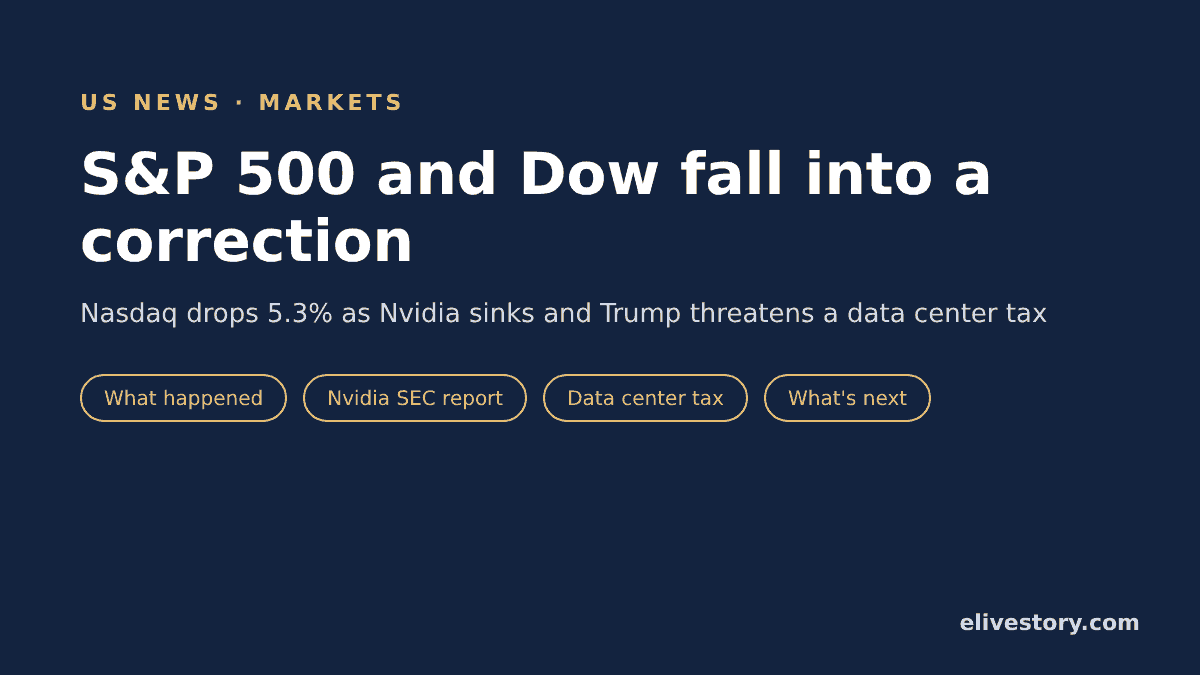
The S&P 500 correction is official. On Friday, Nov. 20, the S&P 500 fell 3.7% to 6,910.39 and the Dow Jones Industrial Average dropped about 950 points, pushing both indexes at least 10% below their recent record highs. The Nasdaq Composite sank 5.3% and wiped out its entire 2026 gain.
The selling was led by artificial intelligence stocks. Nvidia lost about 14% after Reuters reported that the Securities and Exchange Commission is examining potential accounting issues at the company. Anthropic, which began trading only a day earlier, gave back much of its debut pop. And President Donald Trump, speaking at the White House, threatened “a tremendous tax” on U.S. companies that build AI data centers in other countries.
Markets are closed for the weekend. Here’s what happened, what’s confirmed, and what investors are watching when trading resumes Monday.
What happened on Wall Street Friday
The closing numbers, as reported by The Motley Fool’s market data and matched by Fox Business:
- S&P 500: down 265.44 points, or 3.7%, to 6,910.39
- Nasdaq Composite: down 1,261.47 points, or 5.3%, to 22,617.73
- Dow Jones Industrial Average: down 949.73 points, or 1.9%, to 48,147.33
It was the S&P 500’s first close below 7,000 since April, according to The Motley Fool, and the index fell 8.6% for the week. Fox Business reported it was the S&P’s seventh straight losing session, the longest such streak since February 2020.
The Nasdaq’s drop was its second-largest one-day point decline on record, Fox Business said. Citing Reuters, it added that the Nasdaq had its biggest weekly percentage loss since March 2020.
Fear gauges jumped too. The Cboe Volatility Index, known as the VIX, posted its highest close since April 2025, according to Fox Business and a separate market recap that put the close near 36.
What a correction means
A correction is a decline of at least 10% from a recent closing high. A bear market is 20% or more.
Corrections aren’t rare. The Motley Fool, looking at the last 10 S&P 500 corrections, found an average decline of 17%, with two of them turning into bear markets. It also found the index has recovered from every correction, typically reaching a new high within about nine months. History doesn’t promise anything about this one, of course.
Some corners of the market are already deeper in the hole. Before Friday’s open, Schwab reported that 58% of Nasdaq-100 stocks were down 20% or more from their highs.
Why stocks fell: the Nvidia SEC report
Nvidia was the biggest single drag. The stock closed at $125.53, down 14%, per The Motley Fool’s data. Earlier in the session, 24/7 Wall St. reported it was the company’s worst day since the 17% DeepSeek drop of January 2025.
The trigger was a Reuters report, citing two people briefed on the matter, that SEC enforcement staff are examining “potential accounting issues” at Nvidia. Reuters couldn’t determine when the inquiry began or which issues it covers. The SEC declined to comment, and Nvidia didn’t immediately respond, according to 24/7 Wall St. An SEC inquiry isn’t a finding of wrongdoing.
It’s the latest blow to a company already in turmoil. Jensen Huang is out as CEO, with Colette Kress serving as interim chief, and California Attorney General Rob Bonta’s office issued Nvidia an investigative subpoena this week over whether its advanced chips reached China in violation of export rules, CNBC reported. elivestory covered the start of that crisis in our explainer on the Nvidia board’s move against Huang.
Nvidia’s record close was $239.24 on Oct. 6, according to 24/7 Wall St., which estimated roughly $2.7 trillion in market value has been lost since.
Other chip and AI names fell hard. Broadcom dropped about 12% after a report that Google had cut its plans for Broadcom-built AI chips; Google hasn’t confirmed that report.
Anthropic’s rough second day
Anthropic, the AI company behind the Claude chatbot, went public on Thursday, Nov. 19. It closed its first session at $97.17, according to two separate market recaps that put the offer price at $83 a share.
Friday was different. The stock closed at $88.91, down 8.5%, per The Motley Fool’s data, and briefly touched $83.05 midday. CNBC described it as falling “nearly 9%” as tech shares were “shellacked.” Fox Business put the drop at about 9% in the company’s second session as a public company.
That’s still above the offer price. It isn’t clear yet whether the IPO drew money away from other AI stocks or simply got caught in the same wave.
Trump’s data center tax threat
At a White House news conference Friday, shortly after returning from Asia, Trump said tech companies would face a penalty for building AI data centers abroad. The Associated Press quoted him directly:
“We’re not going to allow companies to build data centers in other countries. If they do that, they can. But we’re going to put a tremendous tax on them.”
He gave no details. The AP reported that Trump said he hadn’t yet told his own staff about the idea, and it wasn’t immediately clear how such a tax would be enforced. “We want them to build it here,” he said. Bloomberg and NBC News also reported the threat.
Trump also urged communities that oppose data centers to negotiate rather than block them. “Make them pay you, make them pay your community, but don’t shut them off,” he said, according to the AP. Opposition to data centers was an issue in the midterms, which handed Democrats control of Congress, as we reported in our midterm results breakdown.
The stakes are large. UBS estimates the biggest tech firms could spend up to $1.8 trillion next year, mostly on data centers, the AP reported. Google and Meta officials told the AP they’re working on transparency with communities, but the AP didn’t report a direct company response to the tax threat.
Interest rates and the bigger picture
The Motley Fool listed three broad worries behind the slide: rising interest rates squeezing the AI build-out, the post-midterm backlash against data centers, and the Nvidia crisis.
Rates matter here. Schwab reported Friday morning that futures markets, per CME FedWatch, expect the Federal Reserve to raise its target range by 50 to 75 basis points above the current 3.75%-4% by next June. Higher borrowing costs make it more expensive to finance the enormous data center projects that have powered AI stocks.
Policy toward China is another wild card. “China policy generally is likely to get tougher when Democrats take office in January,” said Michael Townsend, managing director of legal and regulatory affairs at Schwab.
Nathan Peterson, director of derivatives research and strategy at the Schwab Center for Financial Research, said before Friday’s open that “investors are selling into any rallies, rather than buying the pullbacks.” He added: “I’m not sure we have hit ‘capitulation’ yet given the price behavior.”
What happens next
Trading resumes Monday, Nov. 23. It’s a short holiday week.
- Wednesday, Nov. 25: second estimate of third-quarter GDP, October PCE inflation data, durable goods orders and the Fed’s Beige Book
- Thursday, Nov. 26: markets closed for Thanksgiving
- Friday, Nov. 27: stocks close early, at 1 p.m. Eastern
Earnings from Dell, Workday, HP and others are also due during the week, per Schwab’s calendar. After that, the Fed’s December meeting is the next big event for rate expectations.
In my view, the Nvidia story is the one to watch most closely. A reported SEC inquiry with no stated scope leaves a lot of room for rumor, and anything Nvidia or regulators say could move the whole AI group. Any formal plan behind Trump’s tax threat would matter too, though for now it’s only a statement. The president was also traveling in Asia this week, including the three-way meeting with Xi Jinping and Vladimir Putin.
FAQ
Why did the stock market drop today?
Stocks fell sharply on Friday, Nov. 20, 2026, led by AI and chip companies. Nvidia dropped about 14% after Reuters reported an SEC inquiry into potential accounting issues. President Trump also threatened a “tremendous tax” on companies that build data centers overseas, and worries about rising interest rates added pressure.
Is the S&P 500 in a correction?
Yes. The S&P 500 closed at 6,910.39 on Nov. 20, down 3.7% on the day and at least 10% below its recent record, which meets the definition of a correction. The Dow also entered correction territory the same day.
How much did the Dow fall on November 20, 2026?
The Dow Jones Industrial Average fell 949.73 points, or 1.9%, to close at 48,147.33. That drop put the Dow at least 10% below its recent high.
What did Trump say about data centers overseas?
At a White House news conference on Nov. 20, Trump said, “We’re not going to allow companies to build data centers in other countries,” and that companies doing so would face “a tremendous tax.” He gave no details on how it would work, and the AP reported he had not yet told his staff.
Is Nvidia under SEC investigation?
Reuters reported, citing two people briefed on the matter, that SEC enforcement staff are examining potential accounting issues at Nvidia. The SEC declined to comment, and the scope and start date of the inquiry aren’t known. An inquiry is not a finding of wrongdoing.
How did Anthropic stock do after its IPO?
Anthropic began trading on Nov. 19 and closed its first day at $97.17. On Nov. 20 it fell 8.5% to $88.91, which was still above its reported $83 offer price.
Sources: AP via ABC News, Fox Business via AOL, CNBC, 24/7 Wall St. via Yahoo Finance, Charles Schwab, The Motley Fool.
This story is developing and will be updated as markets reopen and more details emerge.
Sources and Editorial Notes
Elivestory aims to use relevant sources, separate confirmed information from speculation and update important details when reliable new information becomes available.

Sarah Jay
Sarah Jay is a journalist, fact-checker, and writer who creates well-researched articles using information from credible and trusted sources. She combines verified facts with thoughtful analysis, offering readers clear, balanced, and insightful perspectives on the topics she covers.
View All Articles