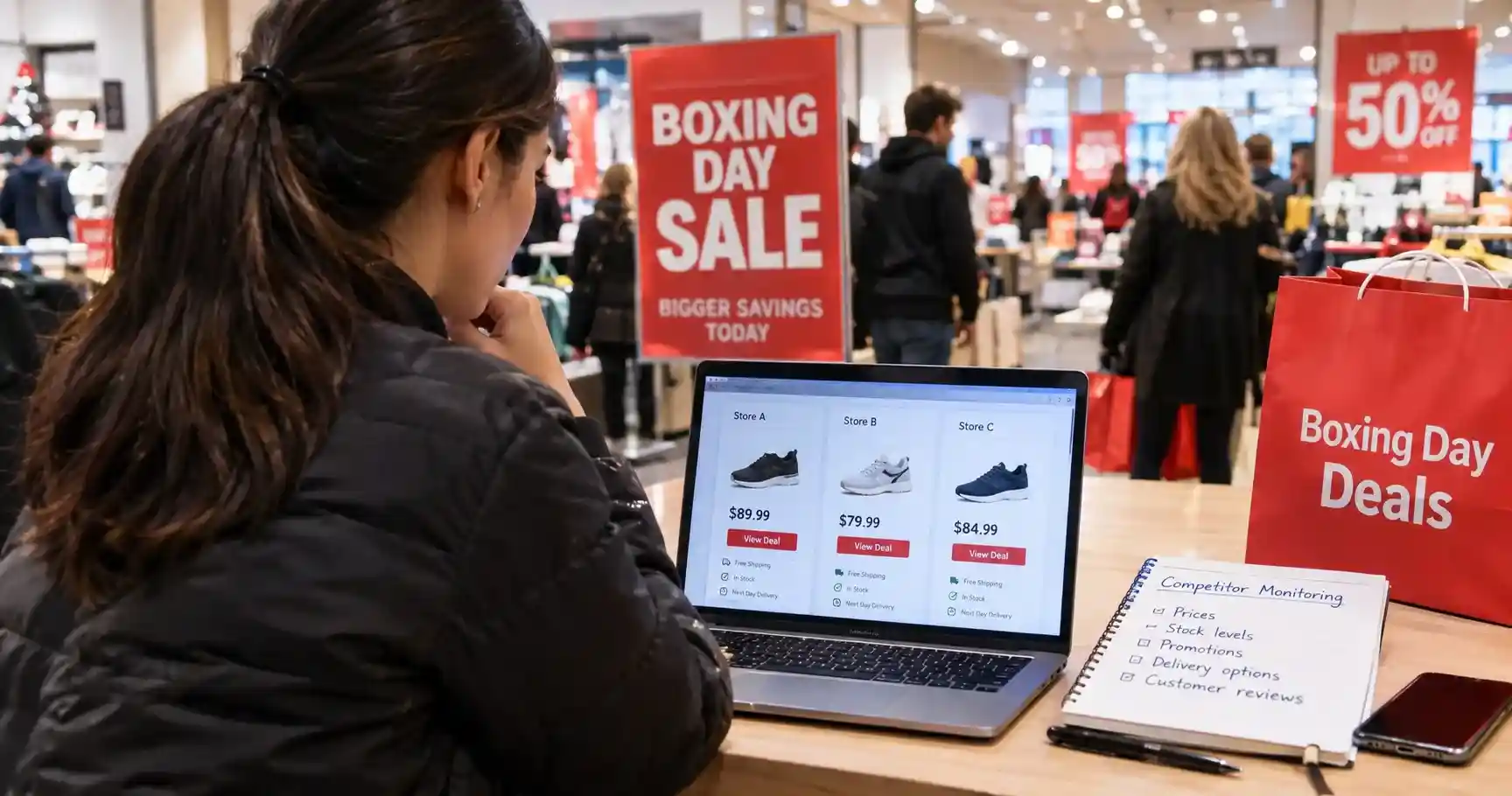
Every year, the retail landscape changes the moment Christmas passes. Storefronts brighten, inboxes fill with promotions, and shoppers begin looking for the best post-Christmas bargains. Boxing Day is not simply another sales event. It is a fast-moving period in which pricing, promotions, inventory, advertising, and customer demand can change within hours.
That is why retailers watch their competitors so closely during Boxing Day deals.
Businesses may monitor competing prices, product availability, promotional messages, shipping offers, advertising activity, and customer responses. The goal is not necessarily to copy another retailer. Instead, competitor monitoring helps businesses understand how the market is changing and decide when they need to adjust their own strategy.
For shoppers, this can make Boxing Day exciting. For retailers, it creates a demanding environment in which every pricing and promotional decision can affect traffic, conversions, inventory, and profit.
Why Boxing Day Deals Create Fierce Competitive Pressure
Boxing Day occupies a unique position in the retail calendar. Christmas has just ended, but many shoppers are still actively looking for purchases, replacements, gifts, household items, electronics, clothing, and other discounted products.
At the same time, shoppers can compare retailers almost instantly.
A customer looking for a television, winter clothing, beauty products, homewares, or automotive accessories can open several websites and compare prices within minutes. A free-shipping offer, a better bundle, or a temporary price reduction can influence where that customer eventually buys.
This creates pressure for retailers to remain aware of what is happening across their market.
A promotion that appears highly competitive in the morning may become less attractive later if another retailer introduces a stronger offer. Likewise, a competitor running out of stock can create an opportunity for another business to highlight comparable products.
The speed of comparison is therefore one of the defining characteristics of modern Boxing Day shopping.
What Retailers Actually Watch During Boxing Day Sales
Price is one of the most visible elements of a retail promotion, but it is not the only factor businesses monitor.
Retailers can track several signals to understand what competitors are doing and how shoppers are responding.
Competitor Pricing
Price monitoring allows retailers to see how aggressively competitors are discounting particular products or categories.
A retailer might discover that a competitor has reduced the price of a popular product by a small amount. Rather than immediately matching it, the business can consider other responses, such as offering free delivery, adding a product bundle, highlighting another model, or emphasizing a different benefit.
This matters because competing purely on price can quickly reduce profit margins.
Product Availability
Inventory is another important signal.
If a competitor sells out of a popular product, other retailers may gain an opportunity to promote similar products. If several businesses have limited inventory in the same category, it can also indicate unusually strong demand.
Stock information therefore provides context that a price alone cannot.
Promotional Messaging
Retailers also pay attention to how competitors present their offers.
One business might emphasize percentage discounts, while another focuses on limited-time offers, bundles, free delivery, loyalty rewards, or product-specific savings.
The wording used in banners, emails, search advertisements, and social media campaigns can reveal which selling points businesses believe will attract shoppers.
Advertising Activity
Digital advertising provides another source of competitive information.
Retailers may monitor search advertisements, social campaigns, email promotions, and prominent website placements to understand where competitors are concentrating their attention.
This does not necessarily mean copying another company’s campaign. Instead, it helps businesses understand the competitive environment surrounding their own products.
Customer Response
Customer comments, reviews, questions, and social media discussions can also provide useful signals.
If shoppers repeatedly complain about shipping costs, product availability, or unclear return policies, retailers can identify areas where their own offer may need improvement.
During a short promotional period, customer feedback can become particularly valuable because purchasing decisions happen quickly.
For example, imagine a homewares retailer noticing that competitors are promoting luxury gift products while shoppers are increasingly searching for practical household items. The retailer might respond by giving greater visibility to blankets, storage products, kitchen accessories, or other practical purchases.
The important point is not copying a competitor. It is responding to changing customer demand.
Timing Can Be Just as Important as Price
One of the biggest challenges during Boxing Day deals is timing.
A promotion that performs well at 8 a.m. may not produce the same results several hours later. Competitors can change prices, launch flash promotions, sell out of popular products, or introduce new bundles throughout the day.
That means retailers often need systems that allow them to make decisions quickly.
Consider an electronics retailer selling a laptop at a competitive price. If several competing stores suddenly reduce prices on comparable models, the retailer has several possible responses.
It could reduce its own price, protect its margin and maintain the existing offer, add an accessory, improve the product presentation, or emphasize a different advantage such as delivery or customer service.
The best response depends on the retailer’s objectives, inventory, margins, and customer base.
This is why effective competitor monitoring is not simply about reacting to every move. It is about collecting information quickly enough to make an informed decision.
How Automotive Boxing Day Deals Fit Into the Competitive Picture
Automotive retail is a useful example of how competitive monitoring can work during Boxing Day promotions.
Shoppers looking for batteries, tools, car-care products, accessories, brake components, or other automotive products may compare prices, specifications, compatibility, warranties, and availability before making a purchase.
During the 2026 Boxing Day period, Repco’s official promotional page says its Boxing Day event is scheduled for December 26, 2026, with deals covering automotive products and options for shopping online or in stores.
For shoppers interested in automotive products, During the Boxing Day deals 2026 event can be a useful reference point when exploring what is available in the category.
For retailers, however, the broader lesson is more important than any single promotion.
A competitor’s discount can provide information about demand, inventory, product positioning, and the promotional strategy being used to attract customers.
For example, if one retailer heavily promotes car-care products while another focuses on tools and accessories, each business can observe which categories receive the strongest customer response.
This illustrates why competitive monitoring extends beyond simply asking, “Who has the lowest price?”
Why Retailers Cannot Focus Only on Discounts
It can be tempting to assume that the retailer with the biggest discount will always attract the most customers.
In reality, shoppers consider multiple factors.
A customer may choose one retailer because it offers free delivery. Another shopper may prefer a business with a clearer returns policy. Someone else may value product availability, loyalty rewards, trusted brands, or convenient click-and-collect options.
That is why retailers need to monitor the entire offer rather than focusing only on the headline price.
A 20% discount may look stronger than a 15% discount, but the second offer could still be more attractive if it includes free shipping or a useful product bundle.
Competitive analysis helps retailers understand these differences.
Brand Positioning Matters During Boxing Day Sales
Boxing Day promotions can also affect how customers perceive a brand.
A retailer that constantly uses deep discounts may attract bargain-focused shoppers but could also influence customers to wait for future sales before purchasing.
On the other hand, a retailer that rarely offers meaningful promotions may struggle to compete for attention during a major shopping period.
The challenge is finding a promotional strategy that fits the brand.
Imagine a retailer that normally positions itself around quality and premium service. If it suddenly cuts prices across almost every product simply because competitors are doing so, the promotion could create confusion.
A more focused approach might be to discount selected products, create useful bundles, or provide an additional service while maintaining the brand’s usual positioning.
Competitor monitoring should therefore inform a retailer’s strategy rather than replace it.
Why Stock Levels Matter as Much as Prices
Inventory can dramatically change the competitive landscape.
Suppose a popular product sells out at several competing retailers. A business that still has sufficient inventory suddenly has an opportunity to capture additional demand.
The reverse can also happen.
If a retailer has too much inventory in a slow-moving category, watching competitors can reveal whether the wider market is experiencing the same problem or whether the issue is specific to that retailer’s pricing or product selection.
This information can help businesses decide whether to change prices, create bundles, adjust advertising, or shift attention toward other products.
During a short sales period, inventory decisions can have a direct effect on both revenue and customer satisfaction.
Competitor Monitoring Is Not the Same as Copying
There is an important distinction between observing competitors and blindly following them.
If another retailer lowers its price, matching that reduction may not always be the right move.
The competing business may have different supplier agreements, inventory costs, operating expenses, customer acquisition costs, or profit margins.
A retailer that automatically matches every competitor discount could end up sacrificing profitability without gaining a meaningful increase in sales.
Instead, businesses can use competitor information as one input in a broader decision-making process.
They can ask:
- Is the competitor’s offer attracting significant attention?
- Is the product directly comparable?
- Does the price change appear temporary?
- Is inventory available?
- Can we offer better value without lowering the price?
- Does responding fit our brand strategy?
- Will the change still make financial sense?
These questions turn competitor monitoring into a strategic activity rather than a race to offer the lowest price.
What Boxing Day Competition Means for Shoppers
Although competitor monitoring is primarily a business activity, shoppers benefit from understanding how it works.
Rapid competition can lead retailers to introduce new bundles, adjust prices, expand promotions, improve delivery options, or increase visibility for particular products.
But consumers should also look beyond the headline discount.
A percentage reduction does not automatically mean the final price is the best available option. Shoppers can compare the total cost, shipping fees, warranties, return policies, product specifications, and retailer reputation before purchasing.
The competitive nature of Boxing Day can create more choices, but it also makes comparison shopping more important.
Read More: Old Time Candy: Fun & Creative Corporate Gift-Giving Ideas
The Real Reason Retailers Keep Watching
At its core, competitor monitoring during Boxing Day is about understanding a rapidly changing market.
Retailers watch competitors because customers can compare offers quickly, promotions can change throughout the day, inventory can disappear unexpectedly, and a small difference in value can influence a purchasing decision.
The most effective approach is not necessarily to copy every competitor move. Instead, businesses can use the information they gather to understand customer demand, evaluate their own offers, protect margins, and respond when a genuine opportunity appears.
That is the hidden strategy behind many Boxing Day deals.
Behind the banners, countdowns, discounts, and promotional emails, retailers are constantly evaluating the market around them. When prices change, bundles appear, products sell out, or a competitor introduces a new offer, businesses have to decide whether—and how—to respond.
For shoppers, it may simply look like another exciting day of post-Christmas savings. For retailers, it is a fast-moving exercise in pricing, positioning, inventory management, and customer understanding.
And that is why the competition does not stop when the Boxing Day sale begins. In many cases, that is when the real strategic work starts.
Sources and Editorial Notes
Elivestory aims to use relevant sources, separate confirmed information from speculation and update important details when reliable new information becomes available.

Editor
Fastlinky is the #1 agency for creative high quality link building services and we are experts in SEO and outreach services that will boost your website's performance.
View All Articles